Приборы и оборудование
Check for visible physical damage __________ turning the power on.
A) inside
B) before
C) across
Observe electrostatic discharge (ESD) precautions __________ opening the device housing.
A) prior to
B) under
C) during
It is allowed to open the panel __________ safety checks are completed.
A) against
B) through
C) after
Take precautionary measures __________ complex technical work.
A) during
B) between
C) into
Do not touch live electrical components __________ the open device.
A) from
B) when working on
C) via
The Central Processing Unit is located __________ the main cabinet.
A) inside
B) across
C) above
Error messages and status updates appear __________ the main screen.
A) into
B) on
C) along
Look at the document revision date __________ the beginning of the manual.
A) at
B) through
C) out of
Check the cable connection __________ the motherboard and the power supply.
A) beside
B) between
C) due to
Disconnect the main power plug __________ the wall socket.
A) from
B) around
C) towards
Always test the machine before placing it __________ operation.
A) under
B) into
C) with
Fluid flows continuously __________ the hydraulic lines during the cycle.
A) through
B) between
C) on
Measure the power supply voltage level __________ the test points.
A) out of
B) across
C) against
The dialysis machine operates stably __________ normal operating conditions.
A) under
B) above
C) into
Unqualified staff cannot touch internal components __________ proper technical training.
A) without
B) into
C) according to
Do not handle live electrical parts __________ wet hands.
A) by
B) with
C) across
Complex maintenance may be performed only __________ authorized personnel.
A) by
B) through
C) along
Tighten all fasteners __________ technical specifications.
A) against
B) according to
C) out of
Protect the printed circuit board __________ water and dust ingress.
A) against
B) along
C) inside
Send the diagnostic report to your laptop __________ the service USB cable.
A) via
B) below
C) under
Complete the sentences with the correct preposition:
Check for visible physical damage __________ turning the power on.
Observe electrostatic discharge (ESD) precautions __________ opening the device housing.
It is allowed to open the panel __________ safety checks are completed.
Take precautionary measures __________ complex technical work.
Do not touch live electrical components __________ the open device.
The Central Processing Unit is located __________ the main cabinet.
Important status and warning messages appear __________ the main screen.
Look at the table of contents __________ the beginning of the manual.
Check the cable connection __________ the motherboard and the power supply.
Disconnect the main power plug __________ the wall socket.
Test the dialysis machine before placing it __________ operation.
Dialysate fluid flows continuously __________ the hydraulic lines during the cycle.
Measure the power supply voltage level __________ the test points.
The system operates stably __________ normal operating conditions.
Unqualified staff cannot touch internal components __________ proper technical training.
Never handle live electrical parts __________ wet hands.
Complex maintenance may be performed only __________ authorized personnel.
Tighten all fasteners __________ technical specifications.
Protect the printed circuit board __________ water and dust ingress.
Send the diagnostic report to your laptop __________ the service cable.
20 Questions for Students
Where is the CPU located in the dialysis machine?
Where do error messages appear when you start the device?
What must you check before turning the power on?
Where do you disconnect the power plug from?
Who can perform complex repairs on this equipment?
What do you need to wear prior to handling chemical disinfectants?
Where is the test equipment placed during maintenance?
When must engineers take precautionary measures?
Where does the dialysate fluid flow during the cleaning cycle?
What should you do after completing the safety checks?
Where do you look to find the hydraulic circuit diagram in the manual?
Can unqualified staff open the device without proper training?
Where is the cable connection checked?
How does the device work under normal operating conditions?
Why do you wear protective gloves when touching components?
What must you protect the circuit board against?
Where do you route the new cables during installation?
How do you transfer the report to your laptop?
What must you turn off when working on live electrical parts?
Where is the heater module placed relative to the rinse chamber?
Повторение
authorized persons
уполномоченные лица / квалифицированный персонал
| Слово / Выражение | Перевод | Простой пример употребления |
| Authorized persons | Уполномоченные лица | Only authorized persons can open the machine. |
| Specialist | Специалист | We need a service specialist today. |
| Qualified engineer | Квалифицированный инженер | Alex is a qualified engineer. |
| Knowledge | Знания | I have knowledge in electronics. |
| Background experience | Базовый опыт работы | He has background experience in medical service. |
| Skills | Навыки, умения | Good skills are necessary for repair. |
| Training | Обучение, подготовка | Engineers complete technical training. |
| Mechanics | Механика | I understand basic mechanics. |
| Electrical engineering | Электротехника | She works in electrical engineering. |
| Safety rules | Правила техники безопасности | You must follow safety rules. |
| Safety regulations | Требования / нормы безопасности | Read the safety regulations first. |
| Precautionary measures | Меры предосторожности | Take precautionary measures during work. |
| Operating conditions | Условия эксплуатации | Check the operating conditions of the device. |
| Equipment | Оборудование | This equipment is ready for use. |
| To observe | Соблюдать (правила) | Engineers must observe safety rules. |
| To carry out | Проводить, выполнять | I can carry out the safety check. |
| To perform | Выполнять, осуществлять | We perform maintenance every month. |
| To inspect | Инспектировать, осматривать | Inspect the cable before work. |
| To repair | Ремонтировать | Can you repair this unit? |
| To service | Обслуживать (технику) | I service dialysis machines. |
| To operate | Работать на оборудовании | Only engineers can operate the system. |
| To touch | Прикасаться, трогать | Do not touch hot components! |
| To require | Требовать, нуждаться | This task requires experience. |
| Can | Мочь, уметь | I can check the water pressure. |
| Cannot / Can't | Не мочь, не уметь / запрещено | Unqualified staff cannot touch wires. |
| Must be (observed) | Должно быть (соблюдено) | Safety rules must be observed. |
| May be (carried out) | Может быть (выполнено) | Maintenance may be carried out by staff. |
| It is allowed | Разрешено | It is allowed to start the test now. |
| It is forbidden | Запрещено | It is forbidden to use damaged cables. |
| To have knowledge in mechanics | Иметь знания в области механики | I have knowledge in mechanics. |
| To follow instructions | Следовать инструкциям | Always follow instructions carefully. |
| Under normal operating conditions | При нормальных условиях эксплуатации | The device works well under normal operating conditions. |
| Only by authorized personnel | Только уполномоченным персоналом | Repair is done only by authorized personnel. |
| To ensure safety | Обеспечивать безопасность | Wear gloves to ensure safety. |
| Before placing into operation | Перед вводом в эксплуатацию | Test the machine before placing into operation. |
Выберите верный предлог из двух вариантов
Check for visible physical damage before / inside turning the power on.
Observe ESD precautions under / prior to opening the device housing.
You can open the panel after / against safety checks are completed.
Take precautionary measures between / during complex technical work.
Do not touch components when working on / via live equipment.
The Central Processing Unit is located across / inside the main cabinet.
Error messages and warning alerts appear on / into the main screen.
Look at the revision date through / at the beginning of the manual.
Check the cable connection between / beside the motherboard and power supply.
Disconnect the main power plug from / around the wall socket.
Test the machine before placing it into / under operation.
Dialysate fluid flows continuously on / through the hydraulic lines.
Measure the power supply voltage level across / out of the test points.
The system operates stably under / above normal operating conditions.
Unqualified staff cannot touch components without / according to proper training.
Never handle live electrical parts by / with wet hands.
Complex maintenance is performed only by / along authorized personnel.
Tighten all fasteners out of / according to technical specifications.
Protect the printed circuit board against / inside water ingress.
Send the diagnostic report to your laptop below / via the service cable.
Say in Russian:
1. Only authorized persons can repair this equipment.
2. A qualified engineer must be present during the start-up.
3. I can carry out the safety inspection today.
4. You cannot touch internal components without training.
5. Technical maintenance may be performed by an authorized specialist.
6. Every technician needs knowledge in mechanics and electrical engineering.
7. All safety rules must be observed during work.
8. Unqualified staff cannot operate this machine.
9. Precautionary measures must be taken to ensure safety.
10. Check the operating conditions before placing into operation.
11. An experienced specialist can inspect the device quickly.
12. Repairs may be carried out only by authorized personnel.
13. You must follow instructions carefully.
14. It is forbidden to use damaged equipment.
15. A specialist can service dialysis machines efficiently.
16. Background experience is required for this complex task.
17. The system works well under normal operating conditions.
18. You cannot start the test without proper skills.
19. It is allowed to open the panel after safety checks.
20. Technicians must complete technical training every year.
Can - cannot / May - may not / Must - must not / It is allowed to - It is not allowed to
Упражнение: Вставьте подходящий предлог
Заполните пропуски предлогами из списка:
before, prior to, after, during, when working on, inside, on, at, between, from, into, through, across, under, without, with, by, according to, against, via
Check for visible physical damage ___ turning the power on. (перед)
Observe electrostatic discharge (ESD) precautions ___ opening the device housing. (до / перед)
It is allowed to open the panel ___ safety checks are completed. (после)
Take precautionary measures ___ complex technical work. (во время)
Do not touch live electrical components ___ live equipment. (во время работы с/над)
The Central Processing Unit (CPU) is located ___ the main cabinet. (внутри)
Error and warning messages appear ___ the main screen. (на)
Look at the table of contents ___ the beginning of the manual. (в — в точке)
Check the cable connection ___ the motherboard and the power supply. (между)
Disconnect the main power plug ___ the wall socket. (из)
Test the dialysis machine before placing it ___ operation. (в / вводить в)
Dialysate fluid flows continuously ___ the hydraulic lines. (через / сквозь)
Measure the power supply voltage level ___ the test points. (между точками / через)
The system operates stably ___ normal operating conditions. (при — условиях)
Unqualified staff cannot touch internal parts ___ proper technical training. (без)
Never touch live electrical parts ___ wet hands. (с / с помощью)
Complex maintenance may be performed only ___ authorized personnel. (кем-то / уполномоченными лицами)
Tighten all fasteners ___ technical specifications. (согласно / в соответствии с)
Protect the printed circuit board ___ water and dust ingress. (от / против)
Send the diagnostic report to your laptop ___ the service USB cable. (через / посредством)
1. check the water supply pressure
2. touch internal components without training
3. carry out safety checks
4. observe safety rules
5. use damaged cables
6. perform maintenance
7. run a T1 test
8. inspect cables and housing
9. operate the device, unqualified staff
10. attach the identification sheet
11. perform disinfection after repairs
12. inspect electrical components
13. skip disinfection after repair
14. check protective earth conductor resistance
15. open the device casing
16. take precautionary measures
17. service the hydraulics and blood modules
18. follow technical instructions
19. complete the TSC report
20. verify operating conditions
Say in English:
1. Сервисный инженер должен проверять заземление. (protective earth resistance)
2. Неквалифицированный персонал не должен использовать плохие кабели.
3. Квалифицированный инженер может делать обслуживание аппарата.
4. Специалист по обслуживанию должен соблюдать правила безопасности.
5. Сервисный техник не должен пропускать дезинфекцию.
6. Дежурный техник должен проверять давление воды. (technician on duty)
7. Авторизованный персонал может открывать корпус. (housing, casing)
8. Инженер службы сервиса должен делать дезинфекцию после ремонта.
9. Стажер не должен открывать корпус. (trainee)
10. Технический специалист должен знать механику и электрику.
11. Сервисный инженер может ремонтировать гидросистему.
12. Техник не должен передавать аппарат пользователю без теста T1.
13. Инженер должен прикреплять лист к отчету.
14. Квалифицированный специалист может проверять электрические детали.
15. Сервисный техник должен осматривать кабели и корпус.
16. Персонал не должен работать без защиты.
17. Оператор не должен запускать тест T1 вместо инженера. (to launch)
18. Авторизованный инженер может заполнять отчет о консервации. (to fill in, report)
19. Специалист по медтехнике должен заполнять отчет (TSC).
20. Сервисный персонал должен читать инструкцию.

Dialogue: Dialysis Machine Maintenance
Persons:
Senior Engineer (Alex)
Junior Engineer (Mark)
Mark: Alex, we need to inspect this dialysis machine. What must I check before turning the power on?
Alex: First, check for visible physical damage and look at the revision date at the beginning of the manual.
Mark: Got it. Where do I disconnect the main power plug from prior to opening the housing?
Alex: Disconnect it from the wall socket and observe ESD precautions prior to opening the device.
Mark: Understood. What safety equipment do I need when working on live electrical parts or chemical lines?
Alex: Never touch components with wet hands, and wear gloves to protect against chemical exposure.
Mark: Okay, the panel is open. Where is the Central Processing Unit located inside the cabinet?
Alex: The CPU is inside the main unit, right beside the motherboard.
Mark: Should I check the cable connection between the motherboard and the power supply now?
Alex: Yes, inspect that cable carefully during your internal visual check.
Mark: Where do error and warning messages appear when we start the diagnostic boot?
Alex: All status updates and error codes appear directly on the main screen.
Mark: Where is the test equipment placed during active voltage measurement?
Alex: Place it next to the device and measure the voltage level across the test points.
Mark: Where does the dialysate fluid flow during the automated cleaning cycle?
Alex: It flows continuously through the hydraulic lines and into the drain tank.
Mark: How does the machine operate under normal operating conditions?
Alex: It operates smoothly under normal conditions without any pressure leaks.
Mark: Can unqualified staff perform this full service without proper technical training?
Alex: No, complex maintenance can be performed only by authorized personnel, so tighten all fasteners according to specs and send the report via USB cable.
Марк: Алекс, нам нужно осмотреть этот диализный аппарат. Что я должен проверить перед включением питания?
Алекс: Сначала проверь на видимые физические повреждения и посмотри дату ревизии в начале руководства.
Марк: Понял. Откуда мне отсоединить сетевой штекер перед вскрытием корпуса?
Алекс: Отсоедини его из розетки и соблюдай правила защиты от электростатического разряда перед открытием прибора.
Марк: Понятно. Какое защитное оборудование мне нужно при работе с электрическими частями под напряжением или химическими линиями?
Алекс: Никогда не трогай компоненты мокрыми руками и надевай перчатки для защиты от воздействия химикатов.
Марк: Хорошо, панель открыта. Где находится центральный процессор внутри корпуса?
Алекс: ЦП находится внутри основного блока, прямо рядом с материнской платой.
Марк: Мне проверить кабельное соединение между материнской платой и блоком питания прямо сейчас?
Алекс: Да, внимательно осмотри этот кабель во время внутреннего визуального осмотра.
Марк: Где появляются сообщения об ошибках и предупреждениях при запуске диагностики?
Алекс: Все обновления статуса и коды ошибок выводятся прямо на главном экране.
Марк: Где размещается тестовое оборудование во время активного измерения напряжения?
Алекс: Поставь его рядом с прибором и измеряй уровень напряжения между контрольными точками.
Марк: Куда течет диализирующий раствор во время автоматического цикла очистки?
Алекс: Он непрерывно течет через гидравлические линии и в дренажный бак.
Марк: Как аппарат работает при нормальных условиях эксплуатации?
Алекс: Он работает плавно при нормальных условиях без каких-либо утечек давления.
Марк: Может ли неквалифицированный персонал выполнять такое полное обслуживание без надлежащей подготовки?
Алекс: Нет, сложное обслуживание выполняется только уполномоченным персоналом, поэтому затяни весь крепеж согласно спецификациям и отправь отчет через USB-кабель.
Повторение
Упражнение 1: Перевод (RU -> EN)
Переведите следующие предложения на английский язык, используя активную лексику курса.
Где я могу найти артикул (P/N) этой электронной платы?
Перед открытием аппарата отключите источник питания
. Вы должны носить защитные очки и маску во избежание заражения
. Техническое руководство находится в приложении
. Не применяйте силу, когда заменяете насос крови
. Какая это версия ПО и какой статус пересмотра документа?
Регулярно смазывайте детали, чтобы предотвратить повреждение устройства
. Посмотрите на оглавление на третьей странице
. Не оставляйте аппарат искусственной почки без присмотра во время тестирования
. Защищайте электронную плату от попадания воды и пыли
. Пожалуйста, затяните крепеж в соответствии с правилами техники безопасности
. Включите микрофон и поделитесь экраном во время видеосвязи
. Снимите перчатки и сразу дезинфицируйте руки
. Слейте диализат из гидравлической системы перед техническим обслуживанием
. Не используйте повторно одноразовые запчасти и фильтры
. Квалифицированный инженер должен проверить сопротивление заземления
. Проверьте условия эксплуатации перед вводом оборудования в эксплуатацию
. Не прикасайтесь к деталям под напряжением мокрыми руками
. Осмотрите все компоненты на наличие повреждений и загрязнений
. Посмотрите на блок-схему, чтобы понять работу гидравлической системы
.
.
Упражнение 2: Выбор глагола (Action Verbs)
Вставьте подходящий по смыслу технический глагол из списка:
Inspect, Calibrate, Drain, Tighten, Lubricate, Replace, Test, Adjust, Measure, Install, Remove, Disconnect, Turn off, Fill, Clean
________ the fluid from the hydraulic system before opening the valves
. ________ all components for cracks and contamination prior to installation
. ________ the screws and fasteners to ensure proper grounding of the device
. ________ the blood pump rotor according to the technical specifications
. ________ mechanical parts regularly to prevent damage to the device
. ________ the mains plug from the power supply prior to opening any housing panels
. ________ the power supply voltage level across the test points during functional tests
. ________ the damaged dialysate line tubing during annual maintenance
. ________ the main switch to avoid electrical shock before servicing live parts
. ________ operating conditions to meet the specific requirements described in the manual
. ________ the new electronic board in reverse order after replacing the defective one
. ________ the blood pump area carefully after a tubing rupture
. ________ the blood pump segment with test solution prior to calibration
. ________ the defective motor from the mounting bracket after loosening the bolts
. ________ output voltage of the power supply before starting troubleshooting on the main board
. ________ protective gloves and a surgical mask when handling contaminated components
. ________ your hands thoroughly immediately after removing the gloves
. ________ the system performance under normal operating conditions
. ________ the software version in the settings tab before starting the diagnostic program
. ________ internal electronic components against the ingress of fluids during fluid calibration
.
Упражнение 3: Модальные глаголы и персонал
Вставьте подходящий модальный глагол (Must, Can, Cannot, Must be, May be):
Only authorized persons ________ repair this equipment
. Every technician ________ follow safety rules during work
. Unqualified staff ________ operate the dialysis machine
. Background experience ________ required for complex tasks
. You ________ touch live parts with wet hands
. A qualified engineer ________ present during the system start-up
. An experienced specialist ________ inspect the device quickly
. Technical maintenance ________ performed by an authorized specialist
. Precautionary measures ________ taken to ensure safety
. Trainees ________ open the main device casing without supervision
. Servicing personnel ________ complete technical training every year
. Technicians ________ skip disinfection after completing the repair
. It is forbidden, so you ________ use damaged power cables
. An authorized engineer ________ carry out safety inspections today
. All safety regulations ________ observed before placing equipment into operation
. A service technician ________ check protective earth conductor resistance
. Operators ________ launch the complex T1 test instead of qualified engineers
. You ________ start troubleshooting without having proper skills and knowledge
. Repairs ________ carried out only by authorized personnel
. A technician on duty ________ verify operating conditions every morning
.
Упражнение 4: Заполнение пропусков (Диалог)
Заполните пропуски подходящими по смыслу словами из списка:
unmute, shared, download, revision, link, table of contents, power supply, live parts, protective gloves, blood pump, hydraulic system, block diagram, calibrate, test equipment, inspect, drain, replace, unattended, safety rules, software version
Senior Engineer: Good morning! Today we are testing this dialysis machine
Junior Engineer: I see it, it is Edition 2024
Senior Engineer: Click on the (3)__________ in the chat tab
Junior Engineer: Done! I have also (4)__________ my screen with you so you can see my tablet
Senior Engineer: Great, but I can’t hear you well. Please (5)__________ your microphone
Junior Engineer: Sorry about that! Can you hear me now? Where can I find the hydraulic circuit in this manual
Senior Engineer: Look at the (6)__________ at the beginning of the book
Junior Engineer: Got it, Section 4. Before we start, what is the (7)__________ on the main screen
Senior Engineer: It shows version 2.1. Everything is ready. Now, put on your (8)__________ and goggles
Junior Engineer: Done! I am ready to open the side panel...
Senior Engineer: Wait! Always turn off the (9)__________ before opening the device housing
Junior Engineer: Right, sorry! I must not touch (10)__________ to avoid electrical shock
Senior Engineer: Correct. Now, (11)__________ all internal components for cracks or contamination
Junior Engineer: The boards look fine, but we need to (12)__________ the fluid from the (13)__________ before removing the valves
Senior Engineer: Good. Also, look at the defective (14). We need to (15) it tomorrow
Junior Engineer: Should I study the (16)__________ to understand the system flow before working on it
Senior Engineer: Yes, study the diagram carefully. Then we will (17)__________ the (18)__________ for functional testing
Junior Engineer: Understood. I will strictly follow all (19)__________ during the procedure
Senior Engineer: Excellent. And remember: never leave the running machine (20)__________ during a test

Lesson Topic: Workplace Equipment and Spare Parts
1. Vocabulary: Tools and Components
Tools & Workplace Equipment (Инструменты и оборудование)
Test equipment — испытательное оборудование
Accessories — аксессуары / принадлежности
Spare parts — запасные части (запчасти)
Electronic catalog — электронный каталог
Technical manual — техническое руководство
Protective gloves — защитные перчатки
Surgical mask — медицинская маска
Goggles — защитные очки
Disinfectant — дезинфицирующее средство
Service technician — сервисный техник
Components & Connections (Компоненты и соединения)
Plug — штекер / разъем
Connection — соединение / подключение
Connector — коннектор / соединитель
Cable — кабель
PCB (Printed Circuit Board) — печатная плата
Motherboard — материнская плата
CPU (Central Processing Unit) — процессор
Blood pump — насос крови
Heparin pump — гепариновый насос
Level detector — датчик уровня
Filter (e.g., Diasafe) — фильтр
Tube — трубка
Heater — нагреватель
Sensor — датчик / сенсор
Display / Screen — дисплей / экран
Power supply unit — блок питания
Shunt interlock — блокировка шунта
Rinse chamber — камера промывки
Pressure transducer — датчик давления
Solenoid valve — электромагнитный клапан
Useful Verbs & Actions (Глаголы и действия)
To connect — подключать
To disconnect — отключать
To replace — заменять
To adjust — настраивать / регулировать
To calibrate — калибровать
To check / To verify — проверять
Prepositions of Time and Place
ий и правила безопасности.
Time & Sequence (Время и последовательность)
Before — перед (чем-то).
Example: Check for visible damage before turning the power on.
Prior to — до / перед (более формальный синоним before).
Example: Prior to opening the device, observe ESD precautions.
When working on... — во время работы над/с...
Example: Do not touch live parts when working on the open device.
Place (Место)
In / Inside — в / внутри. (Example: The CPU is inside the device.)
On — на. (Example: Messages appear on the screen.)
From — из / от. (Example: Disconnect the plug from the socket.)
3. Practice Exercises
Questions for Students (Lesson 3)
What must you check before turning the power on?
When must engineers observe ESD precautions?
When is it safe to open the protective panel?
When should engineers take precautionary measures?
What must you avoid when working on live equipment?
Where is the Central Processing Unit (CPU) located in the main unit?
Where do error messages and status updates appear?
Where do you look to find the document revision date in the manual?
Which connection must you check between the two internal modules?
Where do you disconnect the main power plug from before opening the case?
Where do you place the machine after testing to start using it?
How does dialysate fluid travel through the system during a cycle?
Where do you attach the multimeter probes to measure the power supply voltage?
How does the dialysis machine operate under normal operating conditions?
Can uncertified staff perform internal maintenance without technical training?
How should you handle live electrical components to prevent electrical shock?
By whom can complex technical maintenance be performed?
How must all mechanical fasteners and bolts be tightened?
What must you protect the printed circuit board against during cleaning?
How do you transfer the diagnostic report to your laptop?
Fill in the Prepositions
Complete the sentences using: Before, Prior to, When working on, Inside, On, From.
__________ opening the device, you must wear protective gloves.
Do not touch live parts __________ the open device.
Check the cables __________ you start the T1 test.
The Motherboard is located __________ the device.
Disconnect the main power plug __________ the wall socket.
Check for visible physical damage __________ turning the power on.
Observe electrostatic discharge (ESD) precautions __________ replacing electronic boards.
Warning messages are displayed __________ the screen.
__________ starting maintenance, ensure the machine is disinfected.
Always remove liquids __________ the surface before opening panels.
Wear safety goggles __________ handling chemical disinfectants.
__________ removing the PCB, make sure you are grounded.
The heater elements are placed __________ the hydraulic unit.
Pull the connector carefully __________ the board.
Always read safety instructions __________ performing any service work.
Turn off the power switch __________ replacing fuses.
__________ servicing high-voltage components, unplug the power cable.
Clean all connectors __________ installing the new module.
Do not leave metal tools __________ the cabinet.
Verify all cable connections __________ completing the assembly.
Safety Instructions (Reading True/False)
Read the sentences and mark them as True (T) or False (F).
You can use any generic spare parts, not only original ones. ( )
Wear protective gloves to avoid the risk of infection. ( )
You can connect and disconnect plugs when the device is turned on. ( )
Use the electronic spare parts catalog to identify correct parts. ( )
Always disconnect the power supply before opening protective covers. ( )
Electrostatic discharge (ESD) can damage sensitive PCB components. ( )
You should clean disinfectant spills immediately. ( )
It is allowed to operate the medical equipment without undergoing technical training. ( )
Damaged power cables must be repaired using tape instead of complete replacement. ( )
Check all hydraulic connections for leaks prior to turning on the water supply. ( )
You can touch live electrical parts if you wear thin surgical masks. ( )
Always use original spare parts approved by the manufacturer. ( )
Calibration of sensors can be skipped during annual maintenance. ( )
Protective goggles must be worn when working with chemical disinfectants. ( )
Fuses should be replaced with higher current rating fuses to prevent tripping. ( )
Technical manuals contain necessary safety notes and step-by-step procedures. ( )
You should check test equipment for proper functionality before making measurements. ( )
It is safe to touch heated components immediately after switching off the device. ( )
Never bypass internal safety interlocks during normal operation. ( )
Disconnect all patient connections before performing electrical safety checks. ( )
Identifying Components
Which component or tool is needed for:
Moving blood through the tubing system? → __________
Displaying system status and error messages? → __________
Controlling system logic (the "brain")? → __________
Removing micro-particles and contamination from fluids? → __________
Protecting eyes from chemical splashes? → __________
Protecting hands against biological hazards? → __________
Infusing heparin continuously into the line? → __________
Detecting air or fluid levels in the drip chamber? → __________
Heating dialysate fluid to body temperature? → __________
Connecting electric cables to the circuit board? → __________
Measuring pressure in hydraulic or blood lines? → __________
Locking the shunt connection in place during rinsing? → __________
Disinfecting the fluid pathways and housing? → __________
Converting main AC voltage to regulated DC power? → __________
Opening or closing fluid channels electronically? → __________
Collecting fluid during the cleaning cycle? → __________
Transmitting electrical signals between modules? → __________
Looking up exact part numbers and visual diagrams? → __________
Reading detailed step-by-step repair instructions? → __________
Measuring signal voltages during technical testing? → __________
Before — перед, до
Prior to — до, перед
After — после
During — во время, в ходе
When working on... — во время работы с/над
In / Inside — в / внутри
On — на
At — в, на (в точке)
Between — между
Underneath / Below — под, ниже
Above — над, выше
Next to / Beside — рядом с, около
Around — вокруг, около
From — из, от, с
Into — в, внутрь
Out of — из, наружу
Through — через, сквозь
Across — через, на (между точками)
Along — вдоль, по
Under — при (условиях), под
Without — без
With — с, с помощью
By — кем-то, посредством
In accordance with / According to — в соответствии с, согласно
To / In order to — для, чтобы
Against — от, против (защита)
Due to — из-за, по причине
Instead of — вместо
In case of — в случае
Via / By means of — через, посредством
Переведите:
Предлоги
Before — Check for visible damage before turning the power on.
Prior to — Observe ESD precautions prior to opening the device.
After — It is allowed to open the panel after safety checks.
During — Precautionary measures must be taken during work.
When working on... — Do not touch live parts when working on the open device.
In / Inside — The CPU is inside the device.
On — Messages appear on the screen.
At — Look at the table of contents at the beginning of the book.
Between — Check the connection between the motherboard and the power supply.
Underneath / Below — The heater module is placed underneath the rinse chamber.
Above — The display is mounted above the control panel.
Next to / Beside — Place the test equipment next to the device cabinet.
Around — Inspect the seal around the pump segment.
From — Disconnect the plug from the socket.
Into — Test the machine before placing into operation.
Out of — Take the circuit board out of the protective bag.
Through — Fluid flows through the hydraulic lines.
Across — Measure the power supply voltage level across the test points.
Along — Route the cables along the side frame.
Under — The device works well under normal operating conditions.
Without — You cannot touch internal components without training.
With — Do not handle live components with wet hands.
By — Repair is done only by authorized personnel.
In accordance with / According to — Tighten fasteners in accordance with safety rules.
To / In order to — Wear gloves to ensure safety.
Against — Protect the electronic board against ingress of water and dust.
Due to — The system stopped due to high fluid pressure.
Instead of — Operators must not launch the T1 test instead of qualified engineers.
In case of — Disconnect the main power in case of emergency.
Via / By means of — Transmit data to the PC via the service connector.
Topic: Personnel Requirements and Operating Conditions Требования к персоналу и условия работы
Grammar: Modal Verbs (MUST BE, MAY BE, and CAN / CANNOT)
Target Vocabulary: Qualification & Background (Authorized persons, Knowledge, Background experience, Mechanics, Electrical engineering)
1. Vocabulary (Лексика урока)
authorized persons
уполномоченные лица / квалифицированный персонал
| Слово / Выражение | Перевод | Простой пример употребления |
| Authorized persons | Уполномоченные лица | Only authorized persons can open the machine. |
| Specialist | Специалист | We need a service specialist today. |
| Qualified engineer | Квалифицированный инженер | Alex is a qualified engineer. |
| Knowledge | Знания | I have knowledge in electronics. |
| Background experience | Базовый опыт работы | He has background experience in medical service. |
| Skills | Навыки, умения | Good skills are necessary for repair. |
| Training | Обучение, подготовка | Engineers complete technical training. |
| Mechanics | Механика | I understand basic mechanics. |
| Electrical engineering | Электротехника | She works in electrical engineering. |
| Safety rules | Правила техники безопасности | You must follow safety rules. |
| Safety regulations | Требования / нормы безопасности | Read the safety regulations first. |
| Precautionary measures | Меры предосторожности | Take precautionary measures during work. |
| Operating conditions | Условия эксплуатации | Check the operating conditions of the device. |
| Equipment | Оборудование | This equipment is ready for use. |
| To observe | Соблюдать (правила) | Engineers must observe safety rules. |
| To carry out | Проводить, выполнять | I can carry out the safety check. |
| To perform | Выполнять, осуществлять | We perform maintenance every month. |
| To inspect | Инспектировать, осматривать | Inspect the cable before work. |
| To repair | Ремонтировать | Can you repair this unit? |
| To service | Обслуживать (технику) | I service dialysis machines. |
| To operate | Работать на оборудовании | Only engineers can operate the system. |
| To touch | Прикасаться, трогать | Do not touch hot components! |
| To require | Требовать, нуждаться | This task requires experience. |
| Can | Мочь, уметь | I can check the water pressure. |
| Cannot / Can't | Не мочь, не уметь / запрещено | Unqualified staff cannot touch wires. |
| Must be (observed) | Должно быть (соблюдено) | Safety rules must be observed. |
| May be (carried out) | Может быть (выполнено) | Maintenance may be carried out by staff. |
| It is allowed | Разрешено | It is allowed to start the test now. |
| It is forbidden | Запрещено | It is forbidden to use damaged cables. |
| To have knowledge in mechanics | Иметь знания в области механики | I have knowledge in mechanics. |
| To follow instructions | Следовать инструкциям | Always follow instructions carefully. |
| Under normal operating conditions | При нормальных условиях эксплуатации | The device works well under normal operating conditions. |
| Only by authorized personnel | Только уполномоченным персоналом | Repair is done only by authorized personnel. |
| To ensure safety | Обеспечивать безопасность | Wear gloves to ensure safety. |
| Before placing into operation | Перед вводом в эксплуатацию | Test the machine before placing into operation. |
Say in Russian:
1. Only authorized persons can repair this equipment.
2. A qualified engineer must be present during the start-up.
3. I can carry out the safety inspection today.
4. You cannot touch internal components without training.
5. Technical maintenance may be performed by an authorized specialist.
6. Every technician needs knowledge in mechanics and electrical engineering.
7. All safety rules must be observed during work.
8. Unqualified staff cannot operate this machine.
9. Precautionary measures must be taken to ensure safety.
10. Check the operating conditions before placing into operation.
11. An experienced specialist can inspect the device quickly.
12. Repairs may be carried out only by authorized personnel.
13. You must follow instructions carefully.
14. It is forbidden to use damaged equipment.
15. A specialist can service dialysis machines efficiently.
16. Background experience is required for this complex task.
17. The system works well under normal operating conditions.
18. You cannot start the test without proper skills.
19. It is allowed to open the panel after safety checks.
20. Technicians must complete technical training every year.
Can - cannot / May - may not / Must - must not / It is allowed to - It is not allowed to
1. check the water supply pressure
2. touch internal components without training
3. carry out safety checks
4. observe safety rules
5. use damaged cables
6. perform maintenance
7. run a T1 test
8. inspect cables and housing
9. operate the device, unqualified staff
10. attach the identification sheet
11. perform disinfection after repairs
12. inspect electrical components
13. skip disinfection after repair
14. check protective earth conductor resistance
15. open the device casing
16. take precautionary measures
17. service the hydraulics and blood modules
18. follow technical instructions
19. complete the TSC report
20. verify operating conditions
Say in English:
1. Сервисный инженер должен проверять заземление. (protective earth resistance)
2. Неквалифицированный персонал не должен использовать плохие кабели.
3. Квалифицированный инженер может делать обслуживание аппарата.
4. Специалист по обслуживанию должен соблюдать правила безопасности.
5. Сервисный техник не должен пропускать дезинфекцию.
6. Дежурный техник должен проверять давление воды. (technician on duty)
7. Авторизованный персонал может открывать корпус. (housing, casing)
8. Инженер службы сервиса должен делать дезинфекцию после ремонта.
9. Стажер не должен открывать корпус. (trainee)
10. Технический специалист должен знать механику и электрику.
11. Сервисный инженер может ремонтировать гидросистему.
12. Техник не должен передавать аппарат пользователю без теста T1.
13. Инженер должен прикреплять лист к отчету.
14. Квалифицированный специалист может проверять электрические детали.
15. Сервисный техник должен осматривать кабели и корпус.
16. Персонал не должен работать без защиты.
17. Оператор не должен запускать тест T1 вместо инженера. (to launch)
18. Авторизованный инженер может заполнять отчет о консервации. (to fill in, report)
19. Специалист по медтехнике должен заполнять отчет (TSC).
20. Сервисный персонал должен читать инструкцию.
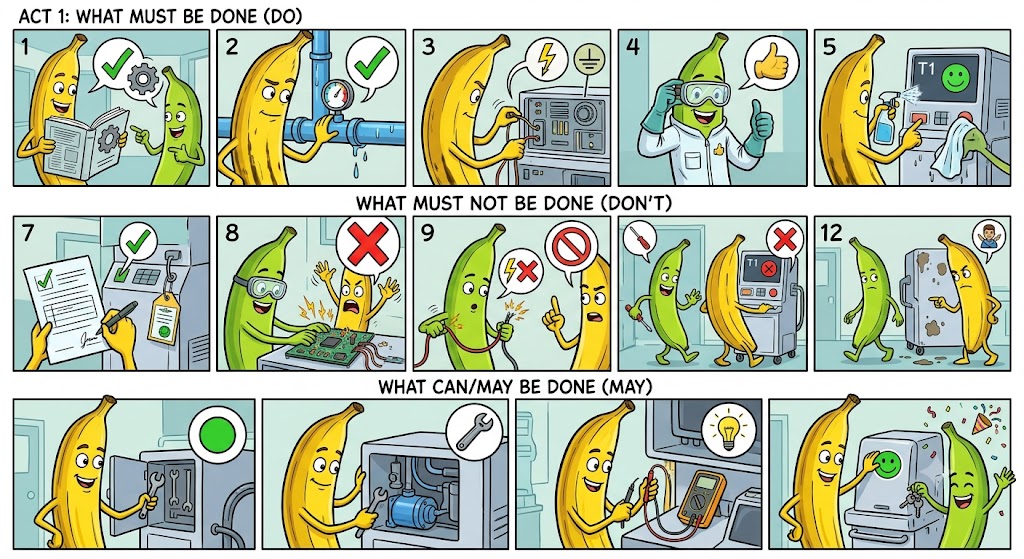
Повторение
Упражнение 1: Перевод (RU -> EN)
Переведите следующие предложения на английский язык, используя активную лексику курса.
Где я могу найти артикул (P/N) этой электронной платы?
Перед открытием аппарата отключите источник питания.
Вы должны носить защитные очки и маску во избежание заражения.
Техническое руководство находится в приложении.
Не применяйте силу, когда заменяете насос крови.
Какая это версия ПО и какой статус пересмотра документа?
Регулярно смазывайте детали, чтобы предотвратить повреждение устройства.
Посмотрите на оглавление на третьей странице.
Не оставляйте аппарат искусственной почки без присмотра во время тестирования.
Защищайте электронную плату от попадания воды и пыли.
Пожалуйста, затяните крепеж в соответствии с правилами техники безопасности.
Включите микрофон и поделитесь экраном во время видеосвязи.
Снимите перчатки и сразу дезинфицируйте руки.
Слейте диализат из гидравлической системы перед техническим обслуживанием.
Не используйте повторно одноразовые запчасти и фильтры.
Квалифицированный инженер должен проверить сопротивление заземления.
Проверьте условия эксплуатации перед вводом оборудования в эксплуатацию.
Не прикасайтесь к деталям под напряжением мокрыми руками.
Осмотрите все компоненты на наличие повреждений и загрязнений.
Посмотрите на блок-схему, чтобы понять работу гидравлической системы.
.
Упражнение 2: Выбор глагола (Action Verbs)
Вставьте подходящий по смыслу технический глагол из списка:
Inspect, Calibrate, Drain, Tighten, Lubricate, Replace, Test, Adjust, Measure, Install, Remove, Disconnect, Turn off, Fill, Clean
________ the fluid from the hydraulic system before opening the valves.
________ all components for cracks and contamination prior to installation.
________ the screws and fasteners to ensure proper grounding of the device.
________ the blood pump rotor according to the technical specifications.
________ mechanical parts regularly to prevent damage to the device.
________ the mains plug from the power supply prior to opening any housing panels.
________ the power supply voltage level across the test points during functional tests.
________ the damaged dialysate line tubing during annual maintenance.
________ the main switch to avoid electrical shock before servicing live parts.
________ operating conditions to meet the specific requirements described in the manual.
________ the new electronic board in reverse order after replacing the defective one.
________ the blood pump area carefully after a tubing rupture.
________ the blood pump segment with test solution prior to calibration.
________ the defective motor from the mounting bracket after loosening the bolts.
________ output voltage of the power supply before starting troubleshooting on the main board.
________ protective gloves and a surgical mask when handling contaminated components.
________ your hands thoroughly immediately after removing the gloves.
Test
Topic: Personnel Requirements and Operating Conditions Требования к персоналу и условия работы
Grammar: Modal Verbs (MUST BE, MAY BE, and CAN / CANNOT)
Target Vocabulary: Qualification & Background (Authorized persons, Knowledge, Background experience, Mechanics, Electrical engineering)
1. Vocabulary (Лексика урока)
authorized persons
уполномоченные лица / квалифицированный персонал
| Слово / Выражение | Перевод | Простой пример употребления |
| Authorized persons | Уполномоченные лица | Only authorized persons can open the machine. |
| Specialist | Специалист | We need a service specialist today. |
| Qualified engineer | Квалифицированный инженер | Alex is a qualified engineer. |
| Knowledge | Знания | I have knowledge in electronics. |
| Background experience | Базовый опыт работы | He has background experience in medical service. |
| Skills | Навыки, умения | Good skills are necessary for repair. |
| Training | Обучение, подготовка | Engineers complete technical training. |
| Mechanics | Механика | I understand basic mechanics. |
| Electrical engineering | Электротехника | She works in electrical engineering. |
| Safety rules | Правила техники безопасности | You must follow safety rules. |
| Safety regulations | Требования / нормы безопасности | Read the safety regulations first. |
| Precautionary measures | Меры предосторожности | Take precautionary measures during work. |
| Operating conditions | Условия эксплуатации | Check the operating conditions of the device. |
| Equipment | Оборудование | This equipment is ready for use. |
| To observe | Соблюдать (правила) | Engineers must observe safety rules. |
| To carry out | Проводить, выполнять | I can carry out the safety check. |
| To perform | Выполнять, осуществлять | We perform maintenance every month. |
| To inspect | Инспектировать, осматривать | Inspect the cable before work. |
| To repair | Ремонтировать | Can you repair this unit? |
| To service | Обслуживать (технику) | I service dialysis machines. |
| To operate | Работать на оборудовании | Only engineers can operate the system. |
| To touch | Прикасаться, трогать | Do not touch hot components! |
| To require | Требовать, нуждаться | This task requires experience. |
| Can | Мочь, уметь | I can check the water pressure. |
| Cannot / Can't | Не мочь, не уметь / запрещено | Unqualified staff cannot touch wires. |
| Must be (observed) | Должно быть (соблюдено) | Safety rules must be observed. |
| May be (carried out) | Может быть (выполнено) | Maintenance may be carried out by staff. |
| It is allowed | Разрешено | It is allowed to start the test now. |
| It is forbidden | Запрещено | It is forbidden to use damaged cables. |
| To have knowledge in mechanics | Иметь знания в области механики | I have knowledge in mechanics. |
| To follow instructions | Следовать инструкциям | Always follow instructions carefully. |
| Under normal operating conditions | При нормальных условиях эксплуатации | The device works well under normal operating conditions. |
| Only by authorized personnel | Только уполномоченным персоналом | Repair is done only by authorized personnel. |
| To ensure safety | Обеспечивать безопасность | Wear gloves to ensure safety. |
| Before placing into operation | Перед вводом в эксплуатацию | Test the machine before placing into operation. |
Say in Russian:
1. Only authorized persons can repair this equipment.
2. A qualified engineer must be present during the start-up.
3. I can carry out the safety inspection today.
4. You cannot touch internal components without training.
5. Technical maintenance may be performed by an authorized specialist.
6. Every technician needs knowledge in mechanics and electrical engineering.
7. All safety rules must be observed during work.
8. Unqualified staff cannot operate this machine.
9. Precautionary measures must be taken to ensure safety.
10. Check the operating conditions before placing into operation.
11. An experienced specialist can inspect the device quickly.
12. Repairs may be carried out only by authorized personnel.
13. You must follow instructions carefully.
14. It is forbidden to use damaged equipment.
15. A specialist can service dialysis machines efficiently.
16. Background experience is required for this complex task.
17. The system works well under normal operating conditions.
18. You cannot start the test without proper skills.
19. It is allowed to open the panel after safety checks.
20. Technicians must complete technical training every year.
Can - cannot / May - may not / Must - must not / It is allowed to - It is not allowed to
1. check the water supply pressure
2. touch internal components without training
3. carry out safety checks
4. observe safety rules
5. use damaged cables
6. perform maintenance
7. run a T1 test
8. inspect cables and housing
9. operate the device, unqualified staff
10. attach the identification sheet
11. perform disinfection after repairs
12. inspect electrical components
13. skip disinfection after repair
14. check protective earth conductor resistance
15. open the device casing
16. take precautionary measures
17. service the hydraulics and blood modules
18. follow technical instructions
19. complete the TSC report
20. verify operating conditions
Say in English:
1. Сервисный инженер должен проверять заземление. (protective earth resistance)
2. Неквалифицированный персонал не должен использовать плохие кабели.
3. Квалифицированный инженер может делать обслуживание аппарата.
4. Специалист по обслуживанию должен соблюдать правила безопасности.
5. Сервисный техник не должен пропускать дезинфекцию.
6. Дежурный техник должен проверять давление воды. (technician on duty)
7. Авторизованный персонал может открывать корпус. (housing, casing)
8. Инженер службы сервиса должен делать дезинфекцию после ремонта.
9. Стажер не должен открывать корпус. (trainee)
10. Технический специалист должен знать механику и электрику.
11. Сервисный инженер может ремонтировать гидросистему.
12. Техник не должен передавать аппарат пользователю без теста T1.
13. Инженер должен прикреплять лист к отчету.
14. Квалифицированный специалист может проверять электрические детали.
15. Сервисный техник должен осматривать кабели и корпус.
16. Персонал не должен работать без защиты.
17. Оператор не должен запускать тест T1 вместо инженера. (to launch)
18. Авторизованный инженер может заполнять отчет о консервации. (to fill in, report)
19. Специалист по медтехнике должен заполнять отчет (TSC).
20. Сервисный персонал должен читать инструкцию.
Повторение
Упражнение 1: Перевод (RU -> EN)
Переведите следующие предложения на английский язык, используя активную лексику курса.
Где я могу найти артикул (P/N) этой электронной платы?
Перед открытием аппарата отключите источник питания.
Вы должны носить защитные очки и маску во избежание заражения.
Техническое руководство находится в приложении.
Не применяйте силу, когда заменяете насос крови.
Какая это версия ПО и какой статус пересмотра документа?
Регулярно смазывайте детали, чтобы предотвратить повреждение устройства.
Посмотрите на оглавление на третьей странице.
Не оставляйте аппарат искусственной почки без присмотра во время тестирования.
Защищайте электронную плату от попадания воды и пыли.
Пожалуйста, затяните крепеж в соответствии с правилами техники безопасности.
Включите микрофон и поделитесь экраном во время видеосвязи.
Снимите перчатки и сразу дезинфицируйте руки.
Слейте диализат из гидравлической системы перед техническим обслуживанием.
Не используйте повторно одноразовые запчасти и фильтры.
Квалифицированный инженер должен проверить сопротивление заземления.
Проверьте условия эксплуатации перед вводом оборудования в эксплуатацию.
Не прикасайтесь к деталям под напряжением мокрыми руками.
Осмотрите все компоненты на наличие повреждений и загрязнений.
Посмотрите на блок-схему, чтобы понять работу гидравлической системы.
.
Упражнение 2: Выбор глагола (Action Verbs)
Вставьте подходящий по смыслу технический глагол из списка:
Inspect, Calibrate, Drain, Tighten, Lubricate, Replace, Test, Adjust, Measure, Install, Remove, Disconnect, Turn off, Fill, Clean
________ the fluid from the hydraulic system before opening the valves.
________ all components for cracks and contamination prior to installation.
________ the screws and fasteners to ensure proper grounding of the device.
________ the blood pump rotor according to the technical specifications.
________ mechanical parts regularly to prevent damage to the device.
________ the mains plug from the power supply prior to opening any housing panels.
________ the power supply voltage level across the test points during functional tests.
________ the damaged dialysate line tubing during annual maintenance.
________ the main switch to avoid electrical shock before servicing live parts.
________ operating conditions to meet the specific requirements described in the manual.
________ the new electronic board in reverse order after replacing the defective one.
________ the blood pump area carefully after a tubing rupture.
________ the blood pump segment with test solution prior to calibration.
________ the defective motor from the mounting bracket after loosening the bolts.
________ output voltage of the power supply before starting troubleshooting on the main board.
________ protective gloves and a surgical mask when handling contaminated components.
________ your hands thoroughly immediately after removing the gloves.
Измерительные приборы
Measuring Instruments